wanting the popcorn to save the film is in bad taste

Monday, August 16, 2010

Men Who Do Not Stare At The Normal Things

8:00 PM Posted by Unknown , No comments

With The Men Who Stare At Goats we are in the land where fantasy and reality roam hand in hand. This is a film based on a book by a journalist who stumbled upon a secret project funded by the US Army to create soldiers with Superpowers. Like walking through walls, becoming invisible and also killing goats by staring at them – therefore the title.

So far so good. We have seen such sci-fi or fantasy stuff. But the director does not treat it like that. This is a spoof, a satire – a commentary on how men go mad in the search for a silly fantasy.

The story is told through the eyes of the journalist on whose book the film is based. Initially he is fascinated by the project but soon he realizes that the soldiers who were part of the project have lost their marbles by abuse of drugs or other experiments.

The film shifts between present day Iraq and the history of the project starting from the late seventies. Most of the stuff is told normally but the characters who are part of the project have a certain edge to their behaviour. They make outlandish claims and are not able to demonstrate their super human skills. Instead of walking through walls, they stare at clouds and make them scatter. Something I remember I used to do a child. And I did not even need any training for it.

At one point Lynn Cassidy (George Clooney) and Bob Wilton (Ewan McGregor) are traveling through Iraq and reach a fork in the road. They do not understand which sign to follow. Lynn keeps staring at it for a long time. He claims that he will soon know the right answer through his psychic powers. When he finally chooses a road, their car is immediately blown up by a land mine. And when such disasters happen Lynn continues as if it was destined to happen.

In the end, the story converges on a similar facility in Iraq where the army is still carrying experiments. Eventually the narrator joins up with the founder of the original project and they are able to free the prisoners on whom new experiments are being conducted.

Somewhere in the middle, one comes across a rare moment in the film that surprises you by its poignancy. Lynn and Bob have escaped a kidnapping and gunfight and are eating at the house of an Iraqi whom they had saved from another kidnapping (I told you it is weird). Lynn apologizes for the gunfight that had been started by private American security forces. The Iraqi apologizes for his countrymen who did the kidnapping. And they continue to eat in the house that has been ransacked when the man was taken away.

Yes this is that kind of a film.

Friday, August 13, 2010

The Expendables

2:24 AM Posted by Gautam Chintamani , No comments

Barney Ross (Sylvester Stallone) leads The Expendables who might be a pack of highly trained mercenaries but all of them are in the twilight of their professional job. Contacted by a man called Mr. Church (Bruce Willis), the Expendables are asked to overthrow a ruthless South American dictator, General Garza (David Zayas). While on a reconnaissance mission Ross and Christmas (Jason Statham) learn that things aren’t as straight as they had expected and decide to pass the job. They escape but Ross can’t get Sandra (Gisele Itie), the dictator’s daughter and their local help, out of his mind. When Gunnar Jensen (Dolph Lundgren), a former Expendable kicked out by Ross, tries to kill him on the behest of James Monroe (Eric Roberts), the rouge CIA agent behind Garza, Ross decides to go back for Sandra alone as there is no money involved but his team- Yin Yang (Jet Li), Hale Caesar (Terry Crews) and Toll Road (Randy Couture) and Christmas won’t let him go alone.

Made on a lavish budget of $82 million The Expendables is a throwback to the old style of action flicks with crazy one-liners every now and then, an explosion here, a chase there and some emotion interludes thrown in for good measure. Written and directed by Sylvester Stallone the film is meant for largely the true fans and even then it’s a little difficult to like this film.

Stallone who has the Rocky series to his credit isn’t the writer that he used to be or perhaps the world isn’t the same anymore. The writing is insipid to say the least and you find it difficult to laugh at the jokes or to emote in a poignant moment. Of course, the film has its moments when everything seems to fit in but suddenly you are reminded of the harsh reality that The Expendables is more like retirement plan for washed out action stars than a film!

The cast of The Expendables looks like a who’s who of the 1980’s. Barring Jason Statham, Stallone gets just about every cult action film regular right from Dolph Lundgren (Universal Soldier), Eric Roberts (Runaway Train), Mickey Rourke and Jet Li besides himself to act in this action film. He even manages to rope in old pals and business partners in Planet Hollywood Arnold Schwarzenegger and Bruce Willis for blink and you miss cameos.

The never ending stag dance that now seems routine and highly boring, The Expendables shows that there’s still some gas in tanks of relics in the form of 3 good lines (one of them being Monroe’s comparison to Gazra’s situation as ‘bad Shakespeare’), 2 good action sequences (especially the one where Christmas and Ross blow up the pier) and 1 really innovative shot even by Stallone standards! The Expendables is tough even if you are a trooper!

Rating: 2 out of 5

Peepli [Live]

12:30 AM Posted by Gautam Chintamani , , , No comments

Unable to pay off the bank’s loan Budhia (Raghuvir Yadav) and Natha (Omkar Das Manikuri) stand to lose their ancestral land. Like millions of farmers across India they have no one to turn to and when they seek help from, Bhai Thakur (Sitaram Panchal), the local MLA, they are that the only way the government can help them is if they were to commit suicide. Burdened by just about everything in sight Budhia, a single man, decides to end his life but Natha won’t have any of it. The two brothers fight it out and ultimately Natha decides to end his life. They celebrate their last few troubled days and Rakesh (Nowaz), a local journalist, ends up overhearing an inebriated Natha’s plan. Miffed with his editor for not treating him well, Rakesh prints Natha’s story sets off a chain of events. The story spreads like a wildfire and every news channel in the nation descends upon the sleepy village of Peepli to capture the first farmer suicide on camera. A simpleton, Natha is unable to fathom the gravity of the situation and soon his life becomes a circus where every one- the local MLA, the state’s Chief Minister, the IAS machinery, the Agriculture Minster and even his own family starts playing him. Natha’s straightforward dream to free his family from the hardships ends up becoming a nightmare that sucks the life out of him.

Simply put Anusha Rizvi’s Peepli [Live] is a very well executed film that not only manages to address a serious political and social issue that has plagued India for some years now but also tells a compelling story. One of the reasons why Peeli [Live] works is the fact that it is written and directed by someone who is far removed from the escapist world of Mumabi filmmaking. Rizvi’s strong political identity administers a script that is deeply rooted in present times and yet never really takes over the narrative of the film.

The film might be about the plight of the poor Indian farmer who has been abandoned by everyone but it rises above the basic premise and makes a bold statement about the sorry state of the manner in which this nation has been functioning. From planning a story just for TRP, politicians out maneuvering each other to remain ahead, the administrative services becoming a lapdog of those in power, the callousness of journalists in their bid to break a story, Peepli [Live] talks about how the common citizens are being hoodwinked at every step of their existence. The scenes where the Block Development Officer tells the powers be that there isn’t a single scheme to help a distressed farmer who is still alive sums up the system’s apparent lack of empathy.

Replete with black humor Peepli [Live] might just the likes of Jaane Bhi Do Yaaron as far as satire in popular Hindi cinema goes. More importantly by managing to bring forth a serious issue without being overtly heavy and yet not sugarcoat the proceedings like a Munnabhai Part 2 or 3 Idiots, Peepli [Live] manages to achieve some thing that most ‘issue’ based commercial films lack.

The first half of Peepli [Live] is really taut and barring the song Mehangai Dayan, which is almost like an interlude, nothing is out of place. Rizvi gets a very gripping performance from her lead Omkar Das Manikpuri and the veteran Raghuvir Yadav, whose camaraderie with Manikpuri forms the backbone of the film. Most of the actors are from the late theatre legend Habib Tanvir’s group Naya Theatre and their excellent casting provides Peepli [Live] a very real and untreated feel. Rizvi’s dialogues provide all the actors especially Natha’s nagging wife Dhaniya (Shalini Vatsa) and his bedridden beedi puffin mother (Farrukh Jaffar) the true fabric to don. Additionally Vishal Sharma and Malaika Shenoy, who play the leading news reporters, get their nuances bang on. Sharma deserves a special mention for fitting well into the know-all-truth-be-danmed sensationalism laden misogynist Deepak. Naseeruddin Shah as the suave minister Salim Kidwai, who says the right thing at the right place is a treat.

Throughout the film Rizvi uses Hori Mahato, a frail farmer who keeps digging the dry earth for reasons no one knows, as the motif of the wounded farmer. The sight of Mahto is strong enough to rattle one’s senses and draws the attention towards the core issue of the film but for a long part she decides to leave things unexplained. Towards the end of the film, Rakesh, the journalist who sets the balling rolling, is moved beyond repair by Mahto’s death and wants to do some thing but is ticked off by Nandita, who like the state sees nothing new or out of the ordinary about his death. To some the ending of Peepli [Live] might seem weak and even unconvincing but the truth of the matter is this film isn’t like a television debate that promises to provide a solution by the end of the program.

Image: Bolly Curry


Friday, August 6, 2010

Predators

4:44 AM Posted by Gautam Chintamani , , No comments

*This review might contain spoilers

Royce (Adrien Brody) wakes up in mid air to find himself tumbling from the sky towards a dense jungle. A mercenary, Royce has no clue about his whereabouts and meets up with other people who seem to have landed on the ground in a similar fashion. The eight of them all have nefarious background except for Edwin (Topher Grace), a doctor, who sticks out like a sore thumb. Becoming the unlikely leader of the pack Royce discovers empty cages and dead bodies as he leads them to higher ground to figure out their location. Soon the group realizes that they are on an alien planet that seems to be a game reserve where they are being hunted by a ruthless alien race simply called Predators.


Back in 1987 when the first Predator hit the screen the big question would have been what the hell is the thing that is hunting the humans but two decades and several sequels later the concept doesn’t really hold any charm. With no surprise in finding out who/ what is hunting them the characters are more concerned with the place they land up in, which kind of adds a little suspense to the film in the initial portions.


Based on an idea submitted by Robert Rodriguez, way back in 1994, Predators is directed by Nimrod Antal, best known for his debut Kontroll, who manages to get the franchise back to its roots. Aiming to do away with the rather cartoonish take that recent Predator films especially Alien vs. Predtor threw up, Antal tries to concentrate more on the mood more than anything. It’s very difficult to look for ‘story’ in such genre films and knowing this only too well, writers Alex Litvak and Michael Finch structure the film in manner that has more style as opposed to substance. Having said that Predators nevertheless manages to hold pretty well for almost two thirds of the film and it’s only when the creatures are visible does the film start to plummet.


Predators is more of a mood piece more than anything. It does have the necessary action sequences, some of the pretty decent and is replete with the customary one-liners but don’t expect the world from the screenplay. Chosen for a specific purpose of ensuring people don’t recall Arnold Schwarzenegger, the original lead, Adrien Brody manages to grunt his way through the role. By the end of the film he starts looking like a walking advertisement for body supplements. The rest of the crew doesn’t really do that bad a job but a little more detailing especially with Laurence Fishburne’s catatonic Noland, would have helped.


The good thing about Predators is that it’s a complete throwback to the old style of action films that rely less on special effects. Even if you aren’t a fan of the series, Predators is decent enough excuse to munch some popcorn.


Rating: 2/5


Image- Movie Moron


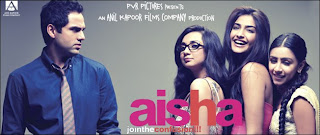
Aisha

2:28 AM Posted by Gautam Chintamani , , No comments
*This article assumes you have seen the film!


The chronicles of aimless rich kids have been the centerpiece of commercial Hindi cinema for decades. Yash Chopra once commented that he made his characters hopelessly rich so that he won’t waste time showing the trials of love conquering the social disparity amongst other things. Karan Johar and the ilk have mastered this craft and now it’s almost impossible to imagine a classic ‘ameer-gareeb pyaar ki kahani’. So Aisha does venture into a relatively new territory as far as the popular Hindi cinema is concerned. Moving beyond GAP as seen on Shah Rukh Khan in KKHH, Aisha showcases Salvatore Ferragamo, Christian Dior, and Chanel as a part of Aisha’s very existence.


No, this isn’t the real reason why Aisha breaks new ground.


Beyond showcasing just about designer parked in the ground floor of DLF Emporio Mall or making the mall which the builder claims to be India's Most Luxurious Shopping Destination almost a room in Aisha’s house, this is the first time a film centers on a spoilt brat who never really transforms into an exemplary citizen!


Aisha lives in a life sized doll house and perhaps never really looks beyond the lunch date or the gig in the evening for which she has found the perfect dress. There isn‘t anything bad in such a character, after all this is a film and one doesn’t expect any life altering solutions from a work of fiction. But isn’t the transformation of a protagonist meant to be the backbone of story? Or could it be that some tales don’t really need characters to live the arc, say for instance, someone like Ram from the Ramayana. While everything and everyone changes in the span of the epic tale, Ram never really transforms. Even when he throws his wife out of his life just because some random person said some thing more random it’s not the part of the main story, if you know what I mean.


Looking back rich spoilt brats might be shining examples of everything good or bad in the society but as far as Hindi films are concerned they have always transformed in the course of the film. A boy agrees to leave his house to rough it out in order to convince the girl’s father that he is more than his father’s son (Maine Pyar Kiya), a troubled rich brat becomes the knight in shining amour for a young widow when love comes to town (Deewana), urged and accompanied by his father to live his life to the fullest we know that Raj will perhaps adorn the cover of Fortune magazine once married to Simran (Dilwale Dhulanhiya Le Jayenge) and some years were enough to make Raj (yeah again) to realize life’s isn’t all ha-ha he-he (Kuch Kuch Hota Hai), Aakash and Sameer might be affable imps but when the time comes they will stop traversing the city for a piece of cake (Dil Chahta Hai). Aisha has learnt not to treat people like projects, won the man of her dreams and even decided to get a job has she really changed? Even though Arjun looks at her as nothing more than a vanglorious brat who is wasting her life away, he can’t help but feel protective and to some extent responsible about Aisha. Aisha realizes her folly when Pinky walks out of her life but even the loss of a childhood friend and Arjun’s taunts don’t really open her eyes. The same thing repeats itself again when Shefali points out some truths but Aisha still never realizes her so called shallowness. Of course, she means no apparent harm and yes at places she operates on very simple Garfield hang-out-with-fatter-people-in-order-to-look-thin logic but nothing seems to get to this woman!


The lead character remains one of the weakest links of Aisha. Aisha’s overbearing presence on the proceedings ends up making all the women characters seem like a bad copy of each other for a larger part of the film. Pinky, Shefali and Aisha are same same but different. Aisha’s friends seem to fulfill two important needs of her- Pinky is the ‘real’ one which ostensibly means what Aisha should never be and Shefali is the ‘new’ one which gives Aisha a chance to ‘start’ all over again. Even Arjun points this out to her but while she thinks of him as the one thing that makes sense in her life, her only connection with the ‘other’ world, she never listens to him.


The men in the film- Randhir, Arjun, Dhurv, Suarabh as well as the elders are well etched and surprisingly have more meat than either Pinky or Aisha. This also seems to be a strange thing keeping in mind Aisha’s creative team is a salute to woman power. There’s not much to think about here- men are, as the parlance of our times goes, easier to understand so Arjun is the man you can take home to meet your mom, Randhir is the rich dude who is very simple scratch-where-it-itches kind of guy, the papa’s the safety net, the uncle is a strong softie, the man servant is a loving punching bag, and Dhruv is the friendly neighborhood hunk who will perfunctory cheat till he’s not married.


Its not that the titular role isn’t well written but it demanded a certain kind of tightrope walk which Sonam Kapoor never gets the hang of. While possessing the correct lineage, Sonam Kapoor just about manages to get Aisha right. Yes, she looks the part, she is stylish, dresses the part and even manages to get nuances right every now and then but one gets a feeling that she is a tad too conscious of the camera. Looking at her performance you tend to get a feeling that she is more consumed by the thought of playing a character like Aisha as opposed to actually playing her! It’s not that Kapoor won’t convince you of Aisha’s impish ways but she looks weak especially when surrounded by some really good characters.


So how come the film still works?


To a great extent its Devika Bhagat’s writing that makes Aisha’s rose tinted world largely believable. Bhagat nattily adapts Jane Austen’s Emma into a world that we might have lived, seen or at least heard about. While I may have not seen Bhagat’s popular TV series (Mahi Way), if her writing in Aisha is a parameter, then I’m sure the show would have been great. Looking at the subject and the credits one would have thought of Aisha as a chick flick or keeping in mind that Anil Kapoor produced this film even worse. Conceived as a vehicle for Sonam Kapoor who wasn’t getting any roles to showcase her talent, Aisha always ran the risk of becoming a vanity project for the star daughter. Thankfully Bhagat’s writing doesn’t allow Aisha to become a full blown Sonam Kapoor show. Managing to infuse life into almost all the character, Bhagat’s writing, that has some excellent lines peppered throughout the film ensures, that her characters don’t remain cardboard cut-outs.


Too much has been said about Sonam Kapoor’s exquisite sense of style and you won’t be let down if that’s what you seek but thankfully Aisha has more to offer than Sonam’s poise.

Click here for my review of the Aisha.

Image- Bollywood Hungama


Friday, May 21, 2010

Kites

6:11 AM Posted by Gautam Chintamani , , , , No comments

J’s (Hrithik Roshan), a Las Vegas based Indian dance instructor, only ambition is to become rich. He marries illegal immigrants for money and doesn’t have any qualms about faking love for Gina (Kangana Ranaut), a casino owner’s (Kabir Bedi) daughter, who falls for him. But everything flips around when he meets Natasha (Barbara Mori), Gina’s to be sister-in-law. J is hopelessly attracted to Natasha, who happens to be Linda, one of the illegal immigrants J married. J and Natasha spend the night before her marriage to Tony (Nick Brown) hanging out together. When Tony catches them in the morning and threatens to kill J, Natasha attacks him and runs off with J. They make a dash for Mexico dodging the police and Tony. As they make a final run J is hit by Tony’s bullet and Natasha leaves him. When he finally comes around three months later J starts looking for Linda.


Kites has been in the making for over two years now and it was supposed to be one of the most awaited films of 2009 but a six month delay followed and now what we have is an but what we have is one unmitigated disaster instead of the film of 2010. While watching one of Hrithik Roshan’s interviews in the lead up to the release he said that ‘every film has its own destiny’ and I couldn’t help but wonder what the hell is he trying to hint.


Hrithik Roshan’s cryptic message becomes as clear as the day once you endure Kites. It seems like Roshan Jr. woke up from the sleepwalk called Kites and started praying hard for suddenly realized what he had on his hands was perhaps the worst film of his decade long career. Well let’s not be so rash. The worst film of his career would be a close call between Yaadein, Mujhse Dosti Karoge, Na Tum Jaano Na Hum but the point one is trying to make here is that this is a man who apparently said no to Swades because the script wasn’t convincing enough. A story, no matter how rudimentary has been the mainstay of Anurag Basu and Rakesh Roshan films and Kites has no story to tell. Basu’s Gangster was a taut thriller which was very deftly crafted but here he trades all that for crazy camera angles and crazier slow motion shots.


It would be difficult to pinpoint what exactly went wrong with Kites simply because there is hardly anything that felt right about the film. A blatant rehash of Woody Allen’s Match Point, the entire first half of the film could have been summarized in a mere 15 minutes. Instead it meanders so much in the first 45 minutes that you lose all interest. For a film about the meeting of two free spirited people (why else would you think this was called Kites!?) who don’t mind tumbling the applecart while answering the call of passion there is no sense urgency in their actions. J is shown to be someone who doesn’t believe in love and all it takes to make him fall head over heels for Linda/ Natasha is one long glance in the rain. She’s passionate about him but is always in tow minds about J even while running away with him. After watching Kites I propose that there should be a fine imposed on films that use more than a handful of slow motion shots. Everything is so trying to be stylish here that everyone gets their own million slow motion walking and giving the look shots.


Hrithik Roshan’s J in Kites tries to be a larger than life presence rather than a convincing performance. Roshan has been careful enough to be a performance driven actor ever since his turnaround with Koi Mil Gaya. So much so that even stands out when he’s playing a spineless film star in Luck By Chance. What’s worse is that this is the first time he suffers the lack of a well defined role in his own production.


When the film had started some where it was meant to be a triangle but by the time it made to the screens Kangana Ranaut was relegated to three dialogues, one song and two scenes where she looks demented. The chemistry between Roshan and Mori has been the conspicuous focus of the film. But does looking at each other endlessly sum up chemistry? Every time the two come face to face, which is almost 90% of the film, everything else simply ceases to exist. To add to the torture every scene between the two seems like the same one played all over again- she talks in Spanish and he just says ‘I don’t know’. Seeing Mori and Roshan romance endlessly and yak non-sense in the name of dialogue one can’t help but wonder if there was ever a script in the first place.


Many people found the first half of Kites to be promising which isn’t totally untrue for when compared with the second half the former is a masterpiece! The entire second half operates on the a pattern of chase, talking back and forth in two languages, action set piece, more lesson in translation and this is repeated over and over again. By the end of you hate the Spanish-English chatter, you hate the rugged countryside and you hate just about everything. Kites, no pun intended is at best a phati patang!


Tuesday, March 23, 2010

Love, Sex Aur Dhokha

4:10 AM Posted by Gautam Chintamani , , No comments

* This review contains spoilers

In a nameless town Rahul, a film student, is making his diploma film and when his leading lady Shruti’s father threatens to put brakes on her short lived career Rahul charms the father into acting as well. Rahul’s camera is always on and records each detail of the love story from the moment he falls in love with Shruti till the time they elope. Adarsh installs security cams in his relatives departmental and gets attracted to the salesgirl. He is up to his neck in debt and when the footage of someone getting shot on the store’s cam fetches money from news channels gives him an idea of making porn clip with Rashmi. The man shot in the store is a news cameraman whose life is going from bad to worse. He ends up saving a small time model’s life who tries to commit suicide after sleeping with a musician for a music video that went to someone else. Together they plan a sting operation on the musician that goes terribly wrong.


The one obvious question that you keep asking yourself throughout the film is just how much does Love, Sex Aur Dhokha (LSD) shock? Does it merely titillate or does it actually deliver. The answer is one big yes. LSD’s experimental outlook goes beyond the medium and tools. The film has long uncut sequences that run into minutes and some times the drama runs the risk of coming across as staged. But the near amateurish performances that Dibakar Banerjee extracts from all his actors proffer a sense of realism to the film.


It’s not unusual for a successful Hindi film director to go nuts with super budgets with each subsequent success but Banerjee comes across as an antithesis to the usual. Banerjee’s decision to work with a small budget and smaller names to follow up the much acclaimed Oye Lucky, Lucky Oye works out well for this is one crazy. Banerjee got the idea of one of the stories while visiting a departmental store that was in the process of putting up CCTV. This is the kind of mood that he has managed to instill in the narrative of the film; some where all the characters seem to float around the camera or the viewer. These are people who are drawn from the lives we lead and while that seems like a perfect hook we don’t really hope to get involved beyond a point. After all the people on screen might look like any one of us but are we really interested in striking affinity with voyeurs, misogynists, liars, cheats, spineless people who seem to be driven by some thing inexplicable. And yet some where we get involved.


In an interview Banerjee says that it’s better to an honest spineless person as opposed to some one who is dishonest about the lies they live. Some where you tend to agree with this kindergarten logic that seems to operate Banerjee’s creative world but you still remain distant with most of his characters. Unlike Khosla Ka Ghosla which redeemed just about every character by the end of film or even Oye Lucky, Lucky Oye, which to a large extent resolves but doesn’t show redemption, LSD has a mixed bag. Using interwoven stories where the leads jump tales Banerjee some how manages to confers a sense of salvation for his characters. Like Pulp Fiction’s ending where a ‘dead’ Vincent walks out of the diner with Jules, here too witnessing Rahul, Shruti, Adarsh and Rashmi at the hospital in the last scene somewhere redeems Adarsh. Seeing a smiling Rashmi in the same scene also provides a sense of hope however small it might be that Rashmi will be fine wherever she might be.


Some where the digital platform has a symbiotic relationship with the film. The medium is effectively used in the narrative of the film and perhaps the platform played a great role in performances as well. It’s only the second story of Adarsh and Rashmi that truly warrants the use of the technology; shown from the security cam’s perspective each scene is well choreographed and truly takes the viewer into the story. The film’s digital platform might give LSD a very real look and feel but it’s really the writing that makes every character very believable. Banerjee returns to the same milieu that he knows like the back of his palm and extracts some really good moments. With Khosla Ka Ghosla he showed us a world that no one cared to notice and with Oye Lucky, Lukcy Oye he explored the dark side of the characters of that very world but this time around he truly bares their perversity for the camera.


The three interwoven tales each dealing with the titular words depict the world around us where no matter how bizarre we are fine with viewing anything that the camera has to offer. No matter which side of the fence you belong to LSD is undoubtedly a very shocking film. Sure we might have heard a couple of crazy lines in Monsoon Wedding, seen some wired things in Dev D (I still haven’t seen Dev D but have heard people talking of it as if it were the greatest thing since sliced bread) but LSD actually convinces for a brief period it convinces you that everyone in this world is vulgar. LSD is not only provocative but shocking and isn’t a film for everyone.


Given the subject of the film Banerjee could’ve justifiably gone overboard with the language and the level of nudity but thankfully keeps it understated so the less actually ends up being more. Just when Adarsh and Rashmi warm up to each other she warns him about the camera. Before turning off the camera he zooms in on the image and takes a long loving look at her on the screen. The next time when a sobbing Rashmi bares her body and offers her soul, a changed Adarsh can’t get himself to switch off the cam. It’s this single shot that packs in the entire essence of Love, Sex Aur Dhokha- does the line between a voyeur and victim still exist?


Image Courtesy: www.indiafm.com